Letter from the editor: 50 years of Scroll

This article was written for BYU-I’s news organization, Scroll.


Did you know that this is the 50th year that our school news organization, Scroll, goes by the name of Scroll?

In 50 years, and over 100 years of local history, Scroll has gone by many titles: Viking FlashesThe Student Rays and The Purple Flash, to name a few. In all these years, all the changes in management, the different styles of editors-in-chief and the stories that affect Rexburg, Scroll remains the same in one fundamental aspect — it’s a platform for writers to learn and grow.

When I came to BYU-Idaho, I felt smaller and quieter than I ever had in my life. I knew that my Father in Heaven loved who I was, but I didn’t believe it. I only knew myself as a girl capable of failure.

Now, despite the challenges I have hidden in the personal corners of my life, I feel larger than life. I feel confident in myself as a leader, a friend, a wife. Having the opportunity as editor-in-chief of Scroll gave me the tangible experience necessary that has verified something: I can accomplish whatever I set my mind to. Now as I embark on my professional career, I know I can handle whatever comes my way.

Trust me, I am terrified and excited to embark in the world outside of college. But, I pray that as Scroll continues to grow, those who take the practicum or work on staff can have a similar experiences. I want them to know they are loved, valued and needed, and that whatever their past, whatever their struggles, there is a place for them at Scroll. Writer or not, creative or not, Scroll is a place to learn and feel included.

In my work as editor-in-chief, the staff and I brought back a printed edition of Scroll, which covered the inauguration of President Meredith. We successfully covered the October 2023 session of general conference. We created a documentary that covered the work of Idaho National Laboratory. We reignited the Journalism Society on campus. We rebuilt our website and reworked our style guide. We dusted, organized and decorated the Scroll office in the back of Spori 114.

The only reason we were able to do all this is through the help of our wonderful faculty, students and staff. So, as the semester rolls to a close and my time as a college student ends, I can only think of one thing to say to those who work with Scroll.

Thank you.
Rexburg’s skate scene: A built-in family

This article was written for BYU-I’s news organization, Scroll.


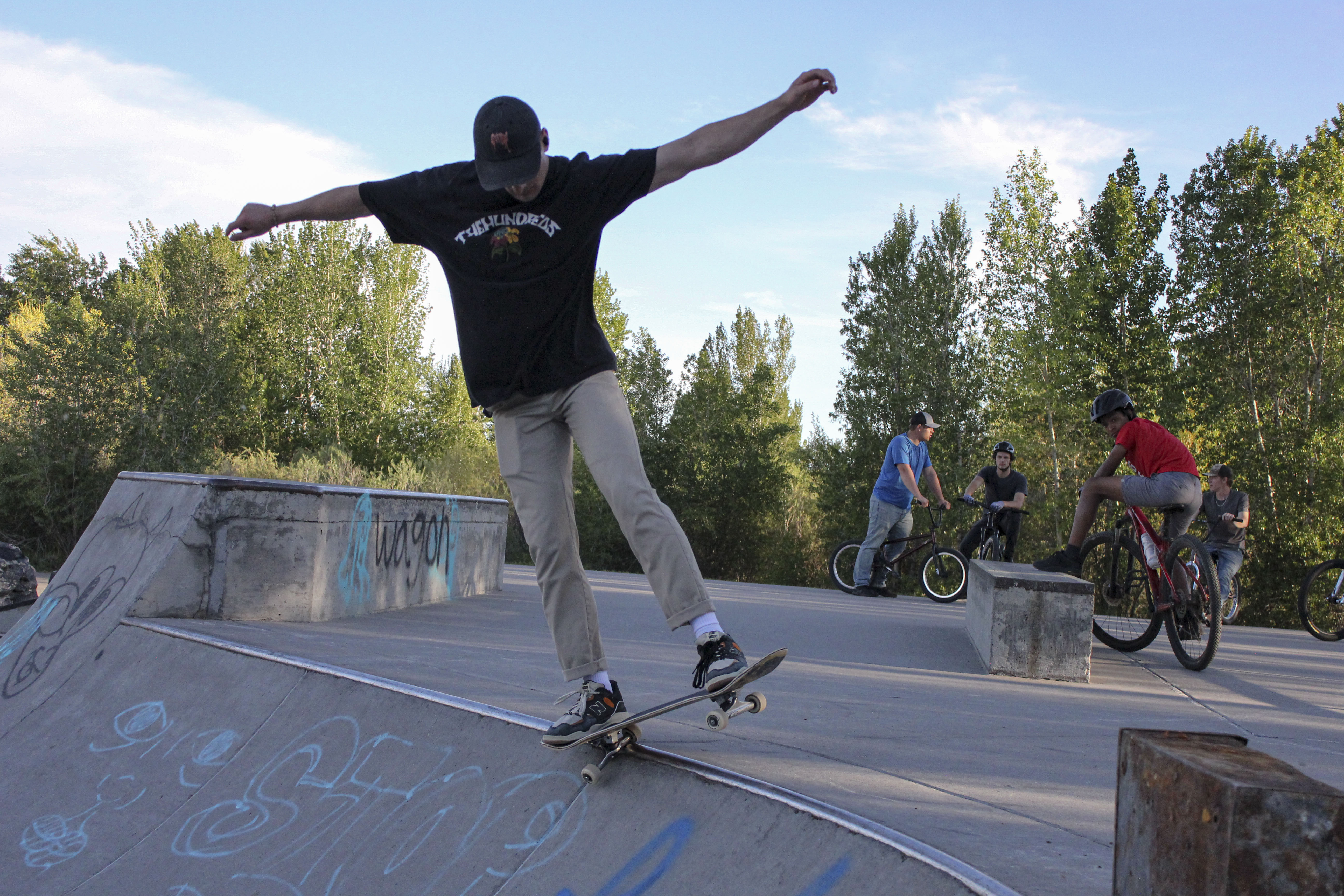
From baggy jeans to checkered Vans, skateboarding culture remains similar worldwide. But nestled in the small town of Rexburg, the atmosphere at the skatepark is a little different than normal, thanks to a strong religious influence and college-town atmosphere.

Mason Clark, a junior studying communication, is one student who lives to skate. Clark spends his free time making skateboarding videos and found it to be his passion.

“I love the skate scene in Rexburg because I feel like I am surrounded by a lot of people I go to school with,” Clark said. “I like that because we all have common ground … no matter how old you are or what level of skateboarding you are in, we can all connect.”

Rexburg’s skate culture runs strong, according to Clark.

“There’s definitely a culture at the skatepark, just like any anywhere,” Clark explained. “Everybody is automatically friends.”

Kalani Azabache, a student studying communication, is also a skater in the Rexburg area.

“I love the skate scene in Rexburg because we are all part of the same team despite our differences,” Azabache said. “There are a lot of young high school kids that come skate with us and it’s fun to hang out with them because they are learning.”

Azabache, otherwise known as “the man that falls the most”, loves the encouraging atmosphere at the park.

“Even when I take the gnarliest slams, everyone still motivates and encourages me to get back up,” Azabache said. “When I do land, everyone is super excited. It’s such a fun time to skate in Rexburg, everyone is like your family there.”

However, nothing comes perfect. Clark and Azabache shed some light on improvements that could be made to the Rexburg skatepark.

“I’ll be completely honest, I love the skatepark at Rexburg, but it’s definitely not made by professionals,” Clark said. “There are a lot of cracks everywhere — I feel like it’s made poorly.”

With chipped concrete and awkward placement, the park is not easy to skate.

“I love skating there with all my heart, but there are a couple of things they could get better,” Azabache said. “The transitions of the park are not the best, I wish it had a better flow to it. I feel like it appeals more to … the regular stance. For us goofy footers, we have to adapt to it.”

Despite its cracks and bumpy transitions, the skatepark holds a special place for Rexburg locals and BYU-Idaho college students.

“I still love the park,” Azabache said. “I’ll still skate there whenever I can.”

Click here to see one of Clark’s videos.

Why I transferred to BYU-I

This is a column piece written for BYU-I’s news organization, Scroll.


“You’re going to hate it.”

That was the response I got when I told my friends and family that I was transferring from Utah State University to BYU-Idaho.

To give context, I graduated high school in 2019 and went to Utah State that fall. I moved to an apartment complex where I didn’t know anyone, worked at a soda shop and took some general classes — your typical Utah college student.

I loved my experience in Logan. The campus was beautiful, my classes were uplifting and my roommates influenced my life in a positive way. While placed in fortunate circumstances, I continued with an aimless direction in my classes and life.

When the pandemic hit and in-person classes were canceled, I was relieved. I was unsure how to handle the college workload, so even though the world was afraid, I felt a weight off my chest. The lockdown ended up being a period of pristine reflection.

On paper, my life seemed complete, but I felt I wasn’t where I needed to be.

I remember sitting in my kitchen and a thought came to my mind, “You could go to BYU-Idaho.”

That sentence was quiet and vague. Although soundless, those thoughts spanned my mind, and I realized I was at a crossroads: I could stay and live my life in Logan or go on a different course in Rexburg.

After reflecting for a few weeks, one of my friends decided to transfer to BYU-I and asked me to be her roommate. To me, that was the push I needed. I didn’t let the confused responses I received cloud my vision, I just did it. I moved to Rexburg, Idaho, in the fall of 2020.

That first semester wasn’t what I had in my head.

The campus looked completely separate from a contemporary university. The people were different, the town was small and I wondered what I had gotten myself into. On day two of living in Rexburg, I called my family and told them that they were right.

But I decided to stay.

Close to two years later, I am a married woman planning to graduate next fall. Looking back, I realize that Rexburg has given me my entire life. This simple town has given me joy, relationships and lessons that are the most beautiful things I can offer from my life thus far.

Nothing is perfect — Rexburg is cold in the winter, hot in the summer and sometimes feels limiting. However, I let that modest location change my world in a positive way.

I started this process by going outside of my comfort zone. I changed my major, applied to be an editor for the school newspaper and spoke up about what was important to me, even if I was afraid of what others had to say. It was how I met my husband and learned to love who I see in the mirror.

If Rexburg is a difficult place for you, I get it. Despite what you have in mind, I encourage students here at BYU-I to take advantage of the social, academic and spiritual opportunities around them because it is more beautiful than you think.

So why did I choose to come to BYU-I? It was because I wanted to. I felt like it would give me a positive change.

Create direction in your life, even if you are discouraged and unsure. Your time here in Rexburg could create a stunning story for you if let it.

Deaf culture shines through in the ASL workshop

A lot of work and thought went into interviewing the students and choosing the direction of my story. As someone with serious hearing loss, deaf representation is a topic I am passionate about. I am happy I was able to shine a light on what deaf culture in eastern Idaho is like.


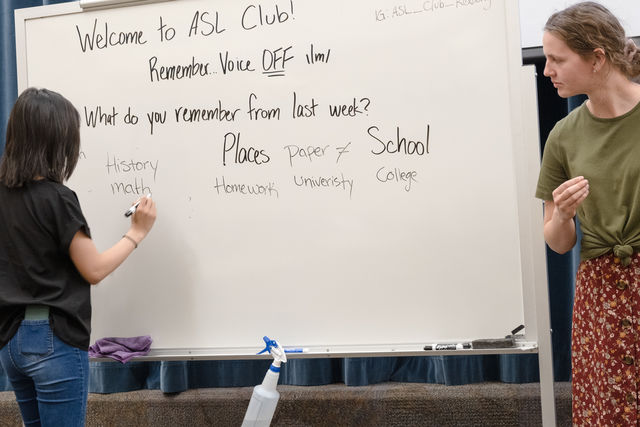
A vibrant silence fills room 286 in the Gordon B. Hinkley building on Tuesday evenings. The numbers are small, but the deaf and hard of hearing student body at BYU-Idaho is a welcoming group, proving that ASL culture runs beyond just the number of deaf students.

Jadyn Townsend, a student studying graphic design, is a part of the deaf community here on campus. Townsend is teaching the ASL workshop this semester, alongside hearing students Katie Stubbs and Kendal Murray.

Townsend shared her experience growing up in the small vacation town of Coeur D’Alene, Idaho, where there was little deaf representation.

“I always have been by myself ever since I was little,” Townsend said. “Back in my hometown, there are no deaf people, so I was mostly isolated all the time until I decided to go to BYU-I. I thought I would be an outcast again — just myself.”

Townsend said that even though she was used to the isolation, she has been able to find her place here in Rexburg.

“There’s not a lot of deaf students here, but I made friends with them and we hang out outside of school,” Townsend said. “It’s nice to have a community, even if it is small, and to see other hearing students wanting to be involved.”

While Townsend has found her niche, most of Idaho’s deaf culture resides in the city of Boise, said Heidi Smith, the Deaf and Hard of Hearing Services Coordinator at BYU-I. She explained that on campus there are “about five deaf students and 15 to 20 hard of hearing students.”

That is where the ASL workshop, also known as “Talking Hands,” comes into play. With participants of different levels chatting and growing their skills, this kind of immersion gives real-world experiences, said Davin Glenn, a senior studying public health.

“The workshop is focused on voices off, and I think it works really well. I’m glad they’re doing it that way,” Glenn said.

Glenn said that even though he is hard of hearing, he does not speak for the deaf community, only his own experiences.

“Having no ASL classes, that makes a dead zone for opportunities,” Glenn explained. “I think ASL classes would really help because it would bring more awareness about the deaf community, even if it is really small. They would feel a lot more included with the student body.”

Despite a lack of ASL classes offered at BYU-I, Smith encourages students to come to the workshop and communicate with people who are different than them.

“It’s okay to try and communicate,” Smith said. “The deaf students are more than willing to teach them sign. They want to communicate and have friendships just like everyone else. Don’t be shy; if you’re interested in making friends with deaf students, just try.”

Click here to view ASL devotionals and here to see the ASL workshop on Instagram.

Grand Targhee removes student season passes

This was the first article I ever wrote for Scroll. I had family connections with Grand Targhee in Alta, Wyoming, so I was able to reach out to the marketing team and get inside information. I received a positive response to this piece, and it remains my most viewed (and personal favorite) article.


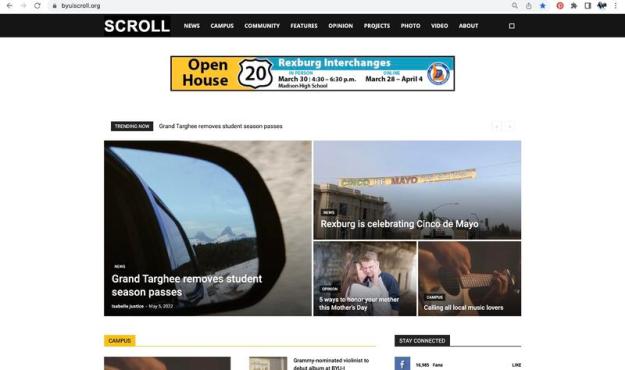
Trending article on the old Scroll website

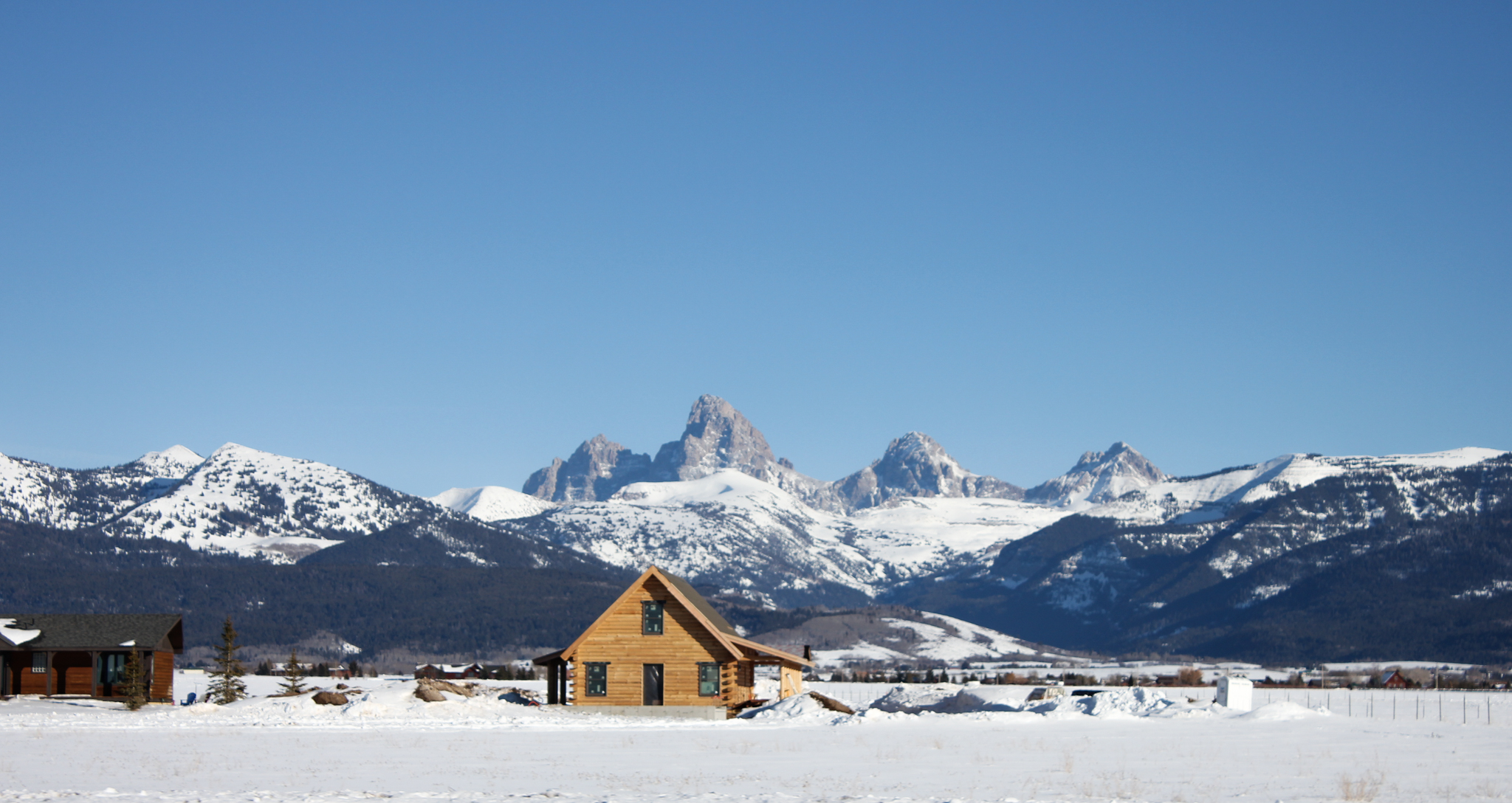
Grand Targhee is a ski and snowboard resort located an hour east of BYU-Idaho in the small town of Alta, Wyoming. Known for its one-of-a-kind snow and views of the Tetons, Grand Targhee offers a small-town and affordable option to enjoy the mountains compared to the Jackson Hole Mountain Resort.

Student passes were originally $370 during the annual April sale. The replacement of a young adult discount caused the prices to rise to $509 during the month of April, $609 from May 1 to Sept. 30 and $899 on Oct. 1, according to Grand Targhee’s website.

Nate Hollingshaus, a junior studying software engineering, was one of the many students from BYU-I affected by this change. To show student backlash toward the removal of the discount, he created an online petition.

“I just wanted to show Targhee how much business they would be missing out on if they didn’t reinstate this pass,” Hollingshaus said. “Maybe if Targhee saw how much this would affect the students and how upset people were, they would reconsider.”

Lack of communication was the most frustrating part of the change for BYU-I students, specifically for those who have been going to Targhee for years.

“Most of my friends and I that have always bought that pass and have been doing it for two to three years,” Hollingshaus said. “I felt like it was a little disrespectful to those kids. There should have been some sort of formal email to those that did have one of the student passes.”

Halle Jae, brand and advertising manager at Grand Targhee, gave clarity on why student passes were discontinued.

“We were having a ton of issues with pass fraud and identifying who was a student, what it meant to be a student and what was fair to everyone,” Jae said. “I feel like there was a lot of controversy along the lines of who falls in this demographic of being able to use this huge discount.”

But college students were not the only reason for this change. Targhee has tailored the young adult pass toward 19 to 22-year-olds in Teton Valley.

“I do think that the kids that are working hard to pay rent in the valley now have this discount available to them,” Jae said. “Now they can ski and ride without being a full-time student and still getting a discount.”

After relaying reasons for ending the student discount, Hollingshaus explained that if Grand Targhee had put a statement explaining these issues, he would have had a different perspective.

“I’ll be honest, that makes sense,” said Hollingshaus. “I would have created a very different petition if I was provided that information … To students, it looks like they were just casting us out.”

Now in May, the season pass sale has ended, and students have come to terms with the young adult price.

“I think at the end of the day, you’ve got to move on,” said Hollingshaus. “I realized I’m married — I got other expenses to pay, and I might not be able to buy a season pass this year. I do think it would be good to have this conversation with Targhee to explain why we were frustrated.”

Skylar Kauf, marketing manager at Grand Targhee, indicated understanding toward those who are affected by the cancellation of the student discount. Kauf explained that Grand Targhee’s intention was not to kick college kids off the slopes but to combat pass fraud and increase inclusivity amongst young adults, specifically those in the Teton Valley.

Only time will tell if BYU-I students will continue the trek to Alta, Wyoming, this winter.

View Nate Hollingshaus’s petition here.