
For communication majors, all students are required to complete a senior project prior to graduation.
For my senior project, I wrote ten articles answering common concerns for elderly clients and their families. Each article was 500 to 1,200 words depending on the topic. This project took me 60 hours to complete.
Senior Solutions is an Idaho Falls-based company that connects elderly clients and their families to local healthcare resources. This includes assisted living homes, hospice care, and home health. Senior Solutions needed a copywriter to improve the quality of their website, and I was thrilled to help.
1. 3 Ways Seniors Can Stay Connected in Eastern Idaho
2. Stay Engaged With Senior Solutions’s Help
3. How To Live A Purposeful Retirement
4. Cognitive Decline In Seniors Explained For Family
5. 5 Ways To Prevent Cognitive Decline In Seniors
6. How Can I Care For A Senior With A Cognitive Impairment?
7. What Is The Difference Between Medicare and Medicaid?
8. Estate Planning For Senior Citizens
9. How To Have An Aging-Friendly Home
10. Senior Housing & Care Explained
You can view the website’s blog posts by clicking here.
How did I do it?
I created a schedule on Google Docs where my ten articles were conveniently located for the CEO. I took in-depth notes recording what he needed answered and tried out two different blog formats.
I dedicated 3 to 4 hours of writing time and 1 hour of editing per article, resulting in 45 hours. The final 15 hours were spent designing my display and booklet, attending class, meeting with my faculty mentor, and coordinating my articles with the CEO of Senior Solutions.
My target audience is seniors 65 years old and older, families who are looking for ways to help their aging relative, and caregivers who are wanting to help.
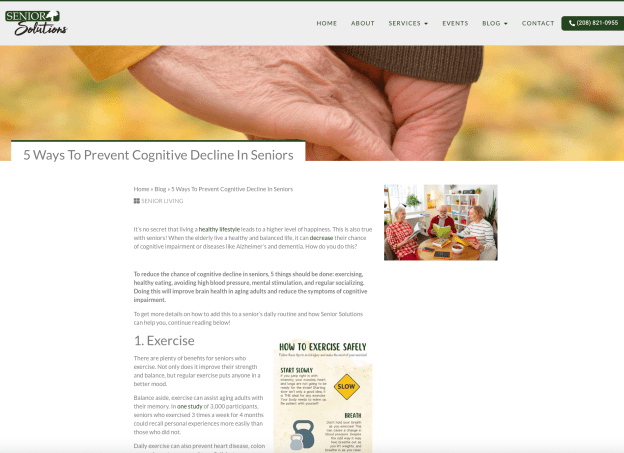
The first format was 1,000-words no matter the topic. After reviewing my blog posts with my faculty mentor, he encouraged me to keep them shorter. The CEO agreed, and we changed our direction. The second format was 500 to 1,200 words and answered fewer questions. The paragraphs were shorter and written using active voice.
I purchased high-quality stock photos for commercial use from the website 123rf.com. I incorporated graphics that were created from the student running the social media, Meagan Rogers.
What were the results?
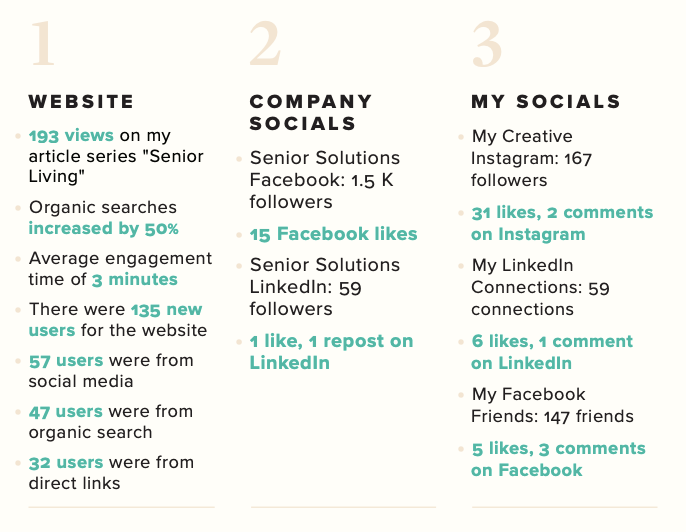
Five of my articles were posted on the company’s Facebook and LinkedIn accounts. I also shared my project on my Instagram and Facebook.
I completed the desired outcomes for this project by successfully writing and editing ten articles that drove viewers to the website. I also increased engagement on company social media accounts.
Below is the PDF I used to print a booklet summarizing the success and showing the statistics of my project.
What did I learn?
I learned how to balance the writing and editing process by planning ahead. I reinforced my eye for design by choosing high-quality photos and graphics to accompany each article. I also practiced designing magazine spreads in Adobe InDesign for my booklet.
My copy editing skills improved tremendously from this project. I took skills I learned from being a desk editor at the Scroll and adjusted it to the client’s needs. I was able to take the CEO’s concerns and eventually understood his style preference without him needing to make many changes.
Although I have done copywriting before, I have never done a campaign like this. This project gave me confidence in my copy skills because I knew my words are directly used to help the community.
 Isabelle Justice