From September to December 2023, I ran an Instagram writing account to showcase my social media and graphic design skills.
Category: Design for Social Media
6 Ways To Write Well (For Beginners)
Writing is a craft, and being a good writer is not something that you are born with. Whether you’ve an avid creative writer or you only write to finish an assignment, there are still ways to improve your work, and I’m here to help.
As a freelance writer, self-published author and Editor in Chief of my school newspaper, I have hundreds of hours of tedious editing and creative writing experience. This article is designed for those who consider themselves beginner writers and want to strengthen their skills. There are 6 tools I use on the daily to make my writing pop, they can be used in academia or just for fun, but I promise they are worth your time.
Let’s get started!
1. Cut the fluff
This may be a first for those who have ever hated writing an English paper in high school, but do not write like you’re trying to reach a word-count. Yes, please toss that mindset out the window, because to write well is to provide a clear opinion or piece of information, not reach the 1,000 word-count that your teacher provided.
If you come across a part in your writing that is quite complicated or you are not confident in, try cutting any extra words by breaking up your sentences. This is a good way to “cut the fluff,” or lose the unneeded words in your piece. You can also look for run-on sentences and find ways to break it up.
2. Use long and short sentences
Think about a famous artist. What makes them good? The best artists are usually multi-faceted, meaning, they can be good at many things. For example, a great artists can create realistic and abstract pieces.
The same is with a good writer.
When you write, use different sentence types. Find ways use long and short sentences. When you have a long sentence, use it as an opportunity to add some rhythm to your article; to explain the technical, the beautiful and the emotional things you want to share. But know when to stop. You can add abruptness, like the flick of a paint brush, to prove your point. Both kinds of sentences are needed, and each make your piece feel like music to write and to read.
3. Understand ‘syntax and ‘prosody’
One of the things I love so much about writing is that there is not always a “right” answer. This isn’t math. There is not rule that can be the only solution. Grammar is the closest thing to a hard and fast writing rule, and even that is relative depending on the style and type of piece you are creating.
So, when you feel the stress to get your writing “just perfect,” and you don’t know the “right” way to do it, take a step back, because writing has two tools to help: syntax and prosody.
Syntax refers to the rules in writing, like the grammar and sentence structure. Prosody means the tone, timing and stress in your writing.
So, syntax is the rules, prosody is the emotion. And that’s it.
For example, every comma I place in this blog post happens because I follow the correct grammar rules. But the words I use, the tone I write in and the placement of my sentence structure is all because of prosody. It’s letting my personality shine, and I love that in writing I can combine rules with expression. I choose how I say what I want to say.
And you can do it too, which is why I am so confident that anyone can write well.

4. Avoid passive voice
The definition of active voice is when the subject performs the action. The definition of passive voice is when the subject of your sentence is acted on by the verb.
The subject of a sentence is any noun that the sentence is about. The verb of a sentence means the action.
Let’s look at an example.
Active voice: The dog chases the ball.
In this example, the subject is “dog,” and the verb is “chases.” Here, the subject, “dog,” is performing the action, which is “chases.”
But when you write in passive voice, this is flipped.
Passive voice: The ball is being chased by the dog.
Now, the verb, “ball,” is acted on by the subject, “dog.”
Makes sense?
If it doesn’t, that’s okay. Here is another tip I have.
Like I said earlier, in writing, we want to be clear. When you write in passive voice, your sentence is typically wordier. You are not as clear, thus losing your reader. Additionally, there are times where you actually need to use passive voice. So, avoid it when you can.
Here are two passages, one that is passive and one that is active, from writerswrite.co.za. See if you can find the difference.
Passive:
The contract was cancelled by the studio managers. Hidden behind their stoic lawyers the messages were passed down. Words like ‘iron clad’ and ‘final notice’ were thrust into their faces. Voices were raised. Emotions were not kept in check. Fury rose unbridled. Tears were making black rivulets down red cheeks. A Union-rep was called. False hopes and empty promises were doled out to hysterical actors. Hands were flying; papers flew even further. Exasperation and desperation were etched on their expressive faces. No acting was required. Unemployment cheques did not promise a merry Christmas.
Active:
The studio managers cancelled the contract. They hid behind their stoic lawyers who passed the message down. The lawyers used words like ‘iron clad’ and ‘final notice’. The actors raised their voices and struggled to keep their emotions in check. Their fury rose unbridled. They cried black tears over red cheeks. They called their union reps who gave them false hopes and made empty promises. They threw their hands and the papers in the air. They were exasperated and desperate. They didn’t need to act this out. They knew unemployment cheques did not promise a merry Christmas.
When you write in active voice, typically, you make more sense to your reader. Your work is also stronger. Sometimes, when I tell my reporters to stop writing in passive voice, I don’t necessarily mean that I check that their sentence structure lines up perfectly with the definition of active voice. I just mean to cut the extra words and be clear. Shorten your sentences. Know when to make it brief and when to expand.
It’s really about following your intuition.
5. What is your main idea?
Let get one thing straight. If you don’t know what you’re talking about, your reader will know. That is why researching your topic before you write is critical to the process.
So, what’s your main idea? Why are you writing this piece?
If you are writing for an assignment, great. What are the instructions for this assignment? Is there a word count? Is there a certain topic your teacher or client wants you to write in a specific way?
If you are writing something for fun, cool! What story are you trying to tell? Is there a lesson you want the reader to learn? How well do you know your characters or your topic?
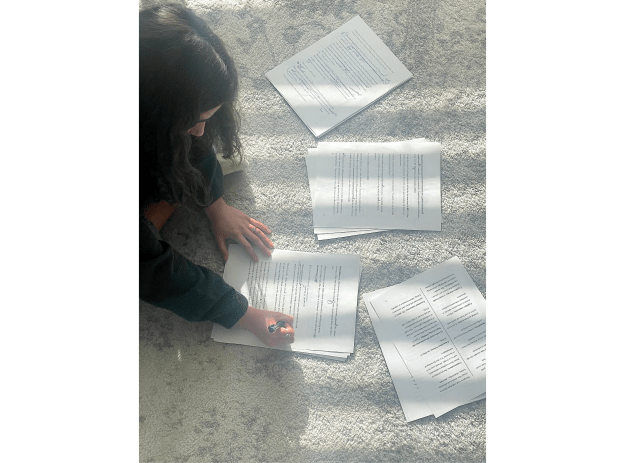
The best way to answer all these questions is to create an outline. It doesn’t need to look a certain way, and there are no right number of bullet points you should have figured out before you create. Once you answer your main idea, and create somewhat of a structure before you begin, it can help you write. Especially if you don’t know where to start.
6. Read it out loud
The last great writing tip I have to share with you is really simple. It has nothing to do with prosody, active voice and outlines.
Read your paper out loud.
You can read it to yourself or a friend, but once you take the brave step of vocalizing your work, it’s easy to see the mistakes. The parts that sound awkward. The sections where you can clearly tell that you don’t know what you’re talking about.
We are our own worst critics, and sometimes it’s helpful when we write. But before you read your paper out loud, make sure to give yourself time to write things down without judgement. Let yourself actually put words to a page before you tear it apart. Allow yourself to create, to write. Only then can you become a good writer.
 Isabelle Justice