BYU-I’s Historian: Passion and Family Over Premise

For a journalism course, I wrote a feature article about the Library Aid in the Special Collections archives at BYU-Idaho. I created a magazine with this content, and below are the results of this project. This article is also on Scroll.


“It’s important that history is recognized as being important,” said Braden. 

His aviator glasses sat comfortably on the bridge of his nose. His honey-blonde hair was tucked behind his ears. His index finger and thumb rested on his chin as he calculated an insightful answer to my overarching question. When I asked Braden Chancellor if it’s important that everyone has a basic knowledge of history, he didn’t give a long-winded answer like I was expecting. He didn’t preach about how the study of history is a dying art, instead, he explained that historians want their profession recognized and respected.

“We have a lot of focus on STEM, right? Just as a university and a nation,” Braden said, his hands danced in the air to emphasize his point. “I think that a focus on STEM is great and some could argue that it has more value, but I know history has a significance that people don’t recognize.”

Many historical texts are located in the Special Collection archives for students to see.

Braden Chancellor is a Library Aide for the Special Collections, an archive on campus that is tucked away on the second floor of the library. It is a place where prehistoric artifacts and the history of Upper Snake River Valley are kept safe. The room itself is quiet. Cozy. Serene. The carpet was brown and blue. Vintage, from the 50s, Braden said. There were shelves of books and bust statues, lines of blue-clothed rocking chairs, and an exhibit about religious texts. Braden pulled a chair for me, and we sat across each other on a long table on the north side of the room.

“I led this,” he said and pointed around at the foam posters and glass containers that surrounded us. Each exhibit protected religious books that were hundreds of years old. “I started getting involved with the exhibits and writing … they said that I was doing a good job and asked if I could be in charge of planning the others.”

While the exhibit sat perfectly in the front of the room, Braden did most of his work in the back. The archives. They spiral like a maze and are only open to the employees.

“At first, I took old materials that people donated and organized them,” he said. “It was just indexing for a little bit, but I wasn’t on that for very long. I got introduced to exhibit planning, right?”

And that’s where his passion lies, he clarified. And as he did, something switched in Braden. His eyes lit up and a smile crept across his face. It’s the kind of smile only those passionate about their career show, and he reminds me of myself. Braden’s niche is history, mine is writing. Writing gives me the space to speak my mind or speak it for others. History gives Braden the space to understand the world. It’s not often that I meet someone so vocal about what they care for. 

“I would love to be in a museum and teach people about history in a creative way,” he said when I asked him about his dream job. “As long as I can make enough to support my family. Whether it’s a city historian, state historian … I like the idea of being able to be a well-respected authority. You want people to say your name and know who they are talking about.”

I asked how he first started to love history. He told me that it was because of the Pirates of the Caribbean movies.

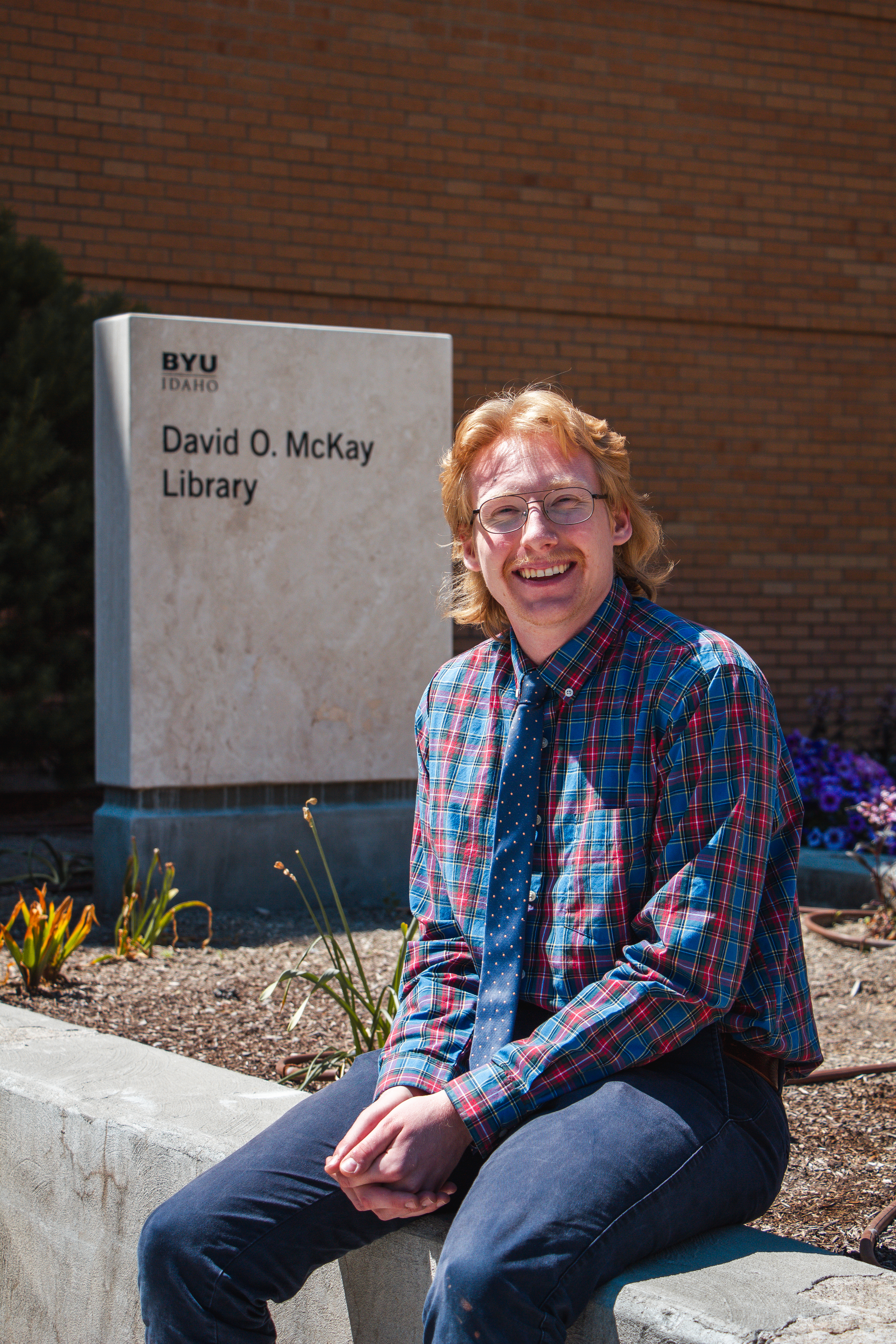
Braden Chancellor in front of the David O. McKay Library at BYU-Idaho.

“I loved learning about these stories,” he said, laughing. “I would get little fact books about pirates and tell my friends and family about what I learned.”

And when Braden got into advanced placement classes in high school, his interest in history blossomed into a passion, one that followed him into his college career. Once at BYU-Idaho, Braden realized that a history degree was more versatile than he originally thought. 

“There is this area of study—it’s kind of new—comes from the 1670’s, and it’s called public history,” he said while tapping his pointer finger on the table. “Examples of that would be working in museums, battlegrounds, and national parks. Those are areas of employment that historians actually get hired to do rather than teaching.”

Braden does what many are afraid to do: follow their dreams. He explained that it was understandable why many don’t, but it’s necessary to follow through with the gifts God has given us. And it’s more than just wishful thinking. Braden completed an internship with The Church of Jesus Christ of Latter-day Saints where he was able to index records that were hundreds of years old. That internship got him his job in the Special Collections.   

And that’s why I interviewed him. Actually, that’s why I interviewed him twice. I couldn’t get enough of Braden’s bright mind, or shake the notion that more people need to be as driven as he is.
“What if this hobby is so important to me that I want it to take eight hours of my day?”

“I received a blessing that said how important my education would be; that I would be able to find a career that supports my family,” he shared. “I think back to why it’s okay that I didn’t pursue a STEM career even if it’s more valuable. It’s because I’m naturally interested in answering these questions.”

Do you think that everyone needs to ask why as you do, I ask.

“I think it’s necessary for some people to ask why in life, but I don’t think it’s necessary for everyone to,” he responds, buckling my argument that everyone needs to be fueled by their interests alone. “There’s going to be some that are curious, and there’s going to be some people who want to take it as it is—that’s okay.”

And then it makes sense: just like it’s not essential to know the periodic table, it’s not crucial that everyone has definite knowledge of history. All he, and historians want, is for us to value them. Include them in the modern discussion too, because they do have a voice.

“I’ve had some people say not to make your hobby your job,” Braden confessed. “What if this hobby is so important to me that I want it to take eight hours of my day? I don’t want to sit in an office and do sales … I want the bulk of my life to be focused on my family. I want history to be a part of it.”
Mary’s Photo

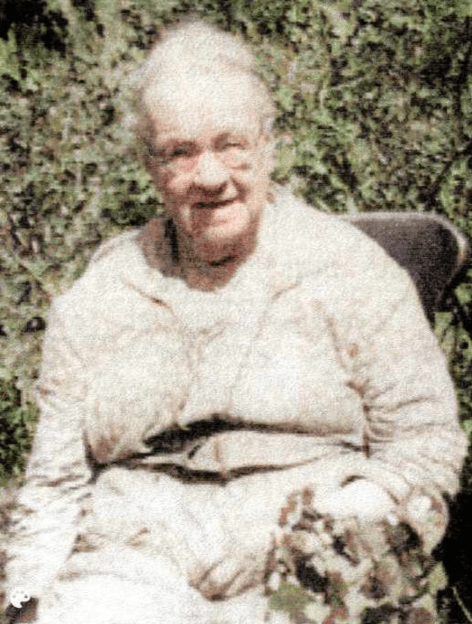
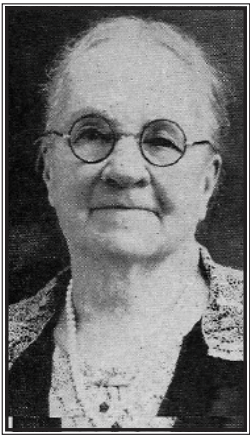
On the cusp of her 80th birthday, Mary got ready for her special day. She fastened a new lace collar for her old black dress and pinned her white hair into a low bun. [1] Her glasses were polished, her hands clean, and shoes tidy.

It was the summer of 1928, and Mary stood in front of the camera man’s massive portrait lens. Her right hand was clasped over her left, resting on her stomach. She was poised but could not help but show a slight smile. It was the good humor that she got from her father.

As she stood still, her eyes showed a story of grief, endurance, and kindness. Life could not, and never would, make her bitter. Little did Mary know that this camera would capture her personality well, hinting at the great life she lived.

The Steps We Have Taken by Julie Rogers

“Three!” shouted the camera man, raising the light.

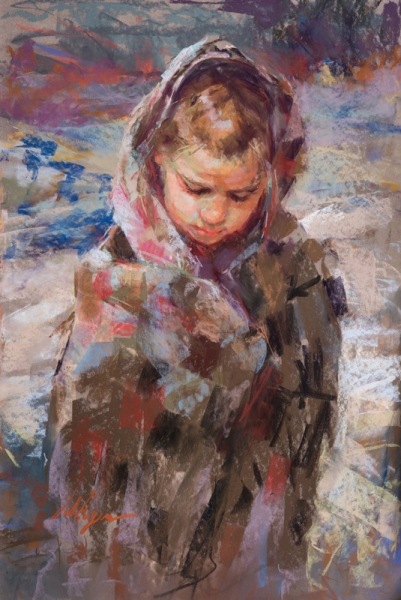
At 7 years old, Mary left England with her parents, grandfather, and sisters to follow the Mormons to the United States. [2] In 1856, little Mary began her journey from Iowa City to the Great Salt Lake in Utah. Soon after Mary left Iowa, her two-week-old baby sister passed. Winter came early, and the company grew weaker as rations ran out. The people that Mary loved, her aunt, grandfather, and playmate, passed away along the trail. Their deaths left a great sadness in her heart. [3]

Mary’s father, James, was intelligent as he was goodhearted. When there was no more food, James unwrapped the rawhide straps off the wagon wheels and boiled them for a treat, a delicacy that Mary thought of often. The journey was so cold that her feet froze, leaving her legs were blue, black, and completely numb. Mary did arrive to her promised land, but she could not walk.

“Two!” The camera man’s thumb pressed down on the trigger.

When the doctor examined Mary’s feet, he advised that they should be amputated. Her father protested, “This little girl didn’t walk a thousand miles to have her legs cut off! If she dies, she dies with her legs on.” [4]

Mary’s neighbor, Mrs. Snider, advised her family to wrap Mary’s feet in frozen beef steaks. She spent three days with her legs cocooned in thawing meat, which were later treated with a homemade ointment. After three long years, she could walk again. [5]

The downside? Pain in her feet for the rest of her life.

Mary’s 80th birthday photo

“One!” shouted the camera man.

Mary was a bride at 16 and the mother of thirteen children, yet the bounds of her love were not confined by blood. [6] Known as “Aunt Mary Wight” by Brigham City locals, she was a natural nurse that always cared for the sick.

At 70 years old, Mary cared for a neighbor’s sick infant.

“Mother! You might be exposing the whole family to something terrible,” her children reported. “You don’t know what the child has. It could have anything!”

“The child is sick,” Mary quickly answered. “A little baby cannot be sick … with Mormon homes about it. Every house has a door. Doors were made to let people in … I think you had better put a bite to eat on the table.”

Mary’s granddaughter wrote that after two days of attentive care, the baby smiled at Mary. He smiled for Mary’s warm home, a clean bed, and food. With a sign of sweet content, his eyes closed and he peacefully passed.

The parents wanted Mary to give a sermon at the child’s funeral and asked how much all her service cost.

Mary Reeder Hurren Wright

“Not a penny,” Mary promised. “My church does not take money for preaching.”

Flash!

Her photograph was taken. When Mary saw it weeks later, she paused. For the first time, she paused for herself.

“My, she’s a big woman, isn’t she? … Do I look like that?” Mary asked.

“You do!” chorused her children.

“I did not know life was doing that to me,” Mary replied.

She dropped her head and wept. In all her life, without taking a second to look in the mirror, she was beautiful. 


Works Cited

[1] Allphin, Jolene Spendlove. Mary Hurren, 2017, www.tellmystorytoo.com/member_pdfs/mary-hurren_1709_401.pdf.

[2] Rogers, Julie. “The Steps We Have Taken.” The Steps We Have Taken, Pioneer Artwork by Julie Rogers, 2018, www.tellmystorytoo.com/fine-arts/julie-rogers/the-steps-we-have-taken.

[3] Hurren, Mary Reeder. FamilySearch.Org, www.familysearch.org/photos/artifacts/125376773?p=53629688&returnLabel=Mary%20Reeder%20Hurren%20(KWNV-7BG)&returnUrl=https%3A%2F%2Fwww.familysearch.org%2Ftree%2Fperson%2Fmemories%2FKWNV-7BG.

[4] Rogers, Julie. “The Steps We Have Taken.” Julie Rogers – Artist, julierogersart.com/the-steps-we-have-taken/.

[5] Jeppsen, Irene. “Mary Hurren’s Journey to Zion.” Mary Hurran 1956 Mary Hurren’s J – FamilySearch.Org, www.familysearch.org/photos/artifacts/102910950?p=53629688&returnLabel=Mary+Reeder+Hurren+%28KWNV-7BG%29&returnUrl=https%3A%2F%2Fwww.familysearch.org%2Ftree%2Fperson%2Fmemories%2FKWNV-7BG.

[6] Baird, Margaret Almina Wight. “She Wouldn’t Do It Any Other Way.” FamilySearch.Org, www.familysearch.org/photos/artifacts/10064038?p=53629688&returnLabel=Mary+Reeder+Hurren+%28KWNV-7BG%29&returnUrl=https%3A%2F%2Fwww.familysearch.org%2Ftree%2Fperson%2Fmemories%2FKWNV-7BG.

What Do You Want To Be When You Grow Up?

There is a video circulating online from the movie The Boy, The Mole, The Fox, and The Horse. In it, a mole asks a boy, “What do you want to be when you grow up?”

The boy responds with one word: kind.

When you are at the ripe age of 10, you may be routinely asked what you want to be when you grow up. The expected answers are career based. Doctor, teacher, scientist, veterinarian. It’s funny. The question itself doesn’t ask for your dream occupation, it asks specifically what you want to be. I love how literal the answer “kind” is. It slaps you back into the reality of what’s most important.

When I was asked this question as a perky elementary school student, I gave a well thought out answer of “artist and author.” I have fulfilled both dreams as a young adult.

When I ask myself this now, I don’t know what to answer anymore. Sure, I have the scripted response of what my plans are after my undergrad, but what I want to be already seems accomplished. I am grown up already! Sometimes it feels like I ran out of life achievements to be proud of.

But maybe what I want to be is just as simple as a child. Maybe I want to be a wife, a mother, a writer, and kind. The dream occupation will find itself as I find myself.

And I’m not quite “grown up” just yet. 22 years old is just scratching the surface of life.

Let ’em talk: How Lorde captures adolescence

Last weekend, I applied for college graduation. While reminiscing on my school experience, I decided to listen to one of my favorite artists. She has stuck by me in my teenage years and into my adulthood. She put into words the feelings I couldn’t understand myself growing up; her name is Ella O’Connor and you may know her as Lorde.

Why Lorde?

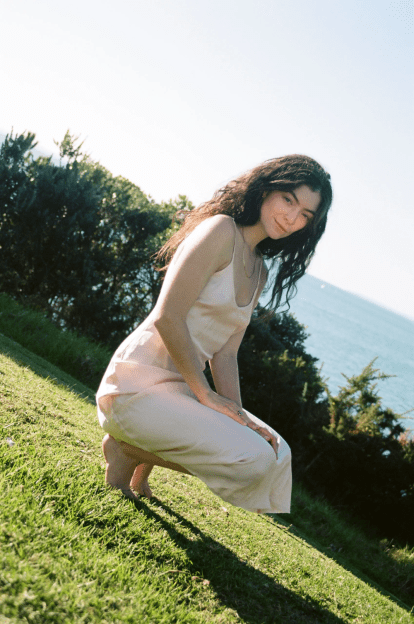
Source: The New Yorker / On “Solar Power,” Lorde Loves the Beach

Ella O’Connor made her debut with her song Royals in 2013. At just sixteen, she ruled the Top 100 Billboards for nine weeks.

It wasn’t until 2016 that I listened to her first album Pure Heroine. This turned into a staple of my sophomore year of high school. She captured what it felt like to be an aimless teenager but she did it with confidence. I admired that.

Her second album, Melodrama, is the perfect modern-day breakup album. Lorde released Melodrama in 2017, and each song collaborates to share the story of a young adult and her ending relationship. Melodrama is a rollercoaster, and it’s always there to pick me right back up.

Lorde’s most recent album came out in 2021 and is named Solar Power. Ironically, this summer-themed album was released after her infamous trip to Antarctica. Solar Power was written through the lens of an older and more mature Ella. She leaves easter eggs for her listeners, like in her track Secrets from a Girl (Who’s Seen it All) where she dresses up as the younger versions of herself in her music video. I feel that each song was written from a positive perspective rather than angst. This album was there to guide me as I figured out adulthood.

Eerily enough, sometimes I feel that her music was made for me. When each album came out, the songs reflected whatever I was going through at that age. Not only is her content relatable to me, but Lorde is a fantastic lyricist. I also believe she is ahead of her time in terms of her sound. The synth-pop from Taylor Swift’s recent Midnights, another favorite of mine, is arguably a reflection of Lorde’s Melodrama which was released five years earlier.

I want to share my favorite song from Ella’s discography, why it’s so important to me, and nuggets of wisdom to take into your own world. I hope you enjoy this personal take on Lorde.

A World Alone

In my opinion, this song is an anthem for existentialism. Existentialism is the philosophy that we are each responsible for creating purpose and meaning in our lives, and it’s not given to us by an outside authority. Lorde’s lyrics resonate with this philosophy, and this ideology aligns well with the mindset of teenagers.

Source: Pinterest (thelordeside.tumblr.com)

Because of this, I admire how A World Alone takes the audience into what it’s like growing up. As a teenager, you’re still so unsure about the world but seldom let it show. Let’s look at the text to prove this; I will cherry-pick lines of the lyrics but will include a link to the song at the end of the article.

The third line starts:

I feel grown up with you in my car

I know it’s dumb

When someone learns how to drive, they have so much freedom in their grasp; they’ve never had that kind of power before. The kind of language, “I know it’s dumb,” is the kind of phrasing you use as a kid. I think this is a nice touch and puts the listener into the mindset of a 16-year-old.

We both got a million bad habits to kick

Not sleeping is one

No explanation is needed. 3 a.m. creative surges were, and still are, the best.

We’re biting our nails

The anxiety that comes with growing up is manifested in our nervous habits.

You’re biting my lip

Teenage romance. What can I say?

I’m biting my tongue

This line is so interesting to me. The phrase “biting my tongue” means not saying everything you want. Is she keeping her thoughts to herself because she is shy in school? Is she keeping parts of herself hidden in a relationship so she doesn’t scare them off?

The people are talking

People are talking

For those teenagers that are quiet, all you see is people talking. People gossiping. People sharing lies. People arguing on the internet. People love to talk.

Let ‘em talk

Cause we’re dancing in this world alone

World alone, we’re alone

Her transition to the end of the chorus is powerful, not only because of the words she uses but the beat behind it. Lorde points out the shallowness of people around us with “the people are talking,” but implies that it doesn’t really matter with “let ’em talk.” I also love the subtle difference between “world alone” and “we’re alone.”

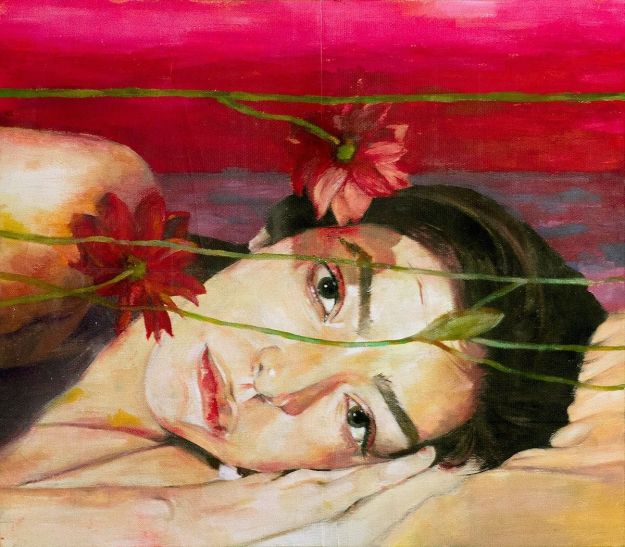
Source: Pinterest / Artist @fakinglory

All my fake friends all of their noise

. . .

Maybe the internet raised us

Or maybe, people are jerks

But not you

I like this part. Although there are fake people in the world, it’s not entirely the internet’s fault. People have been unkind before the computer age, it’s not because the internet “raised us.” Maybe the internet has provided us with an outlet for our harshness, highlighting the good and bad of humankind.

I know we’re not everlasting

We’re a train wreck waiting to happen

One day the blood won’t flow so gladly

One day we’ll all get still

And the people are talking

Let ‘em talk

Chilling. This suggests that despite our mortality, people will continue to be negative. However, by focusing on negativity, we may miss out on valuable experiences. This message could apply to both others and ourselves. It makes me wonder if I am prioritizing things that are unimportant in the grand scheme of things, and I think this is the most important takeaway from the song.

I believe Lorde is saying to genuinely forget what others think and live your truth. You can imagine the confidence boost this song gave me as a 16-year-old. You can appreciate even more the reminder of it at almost 22.

Takeaway: there is no need to mimic the poor behavior of others because our life will be over before we know it. Go to the rhythm of your own muse, and let ’em talk.

2013 Universal Music NZ